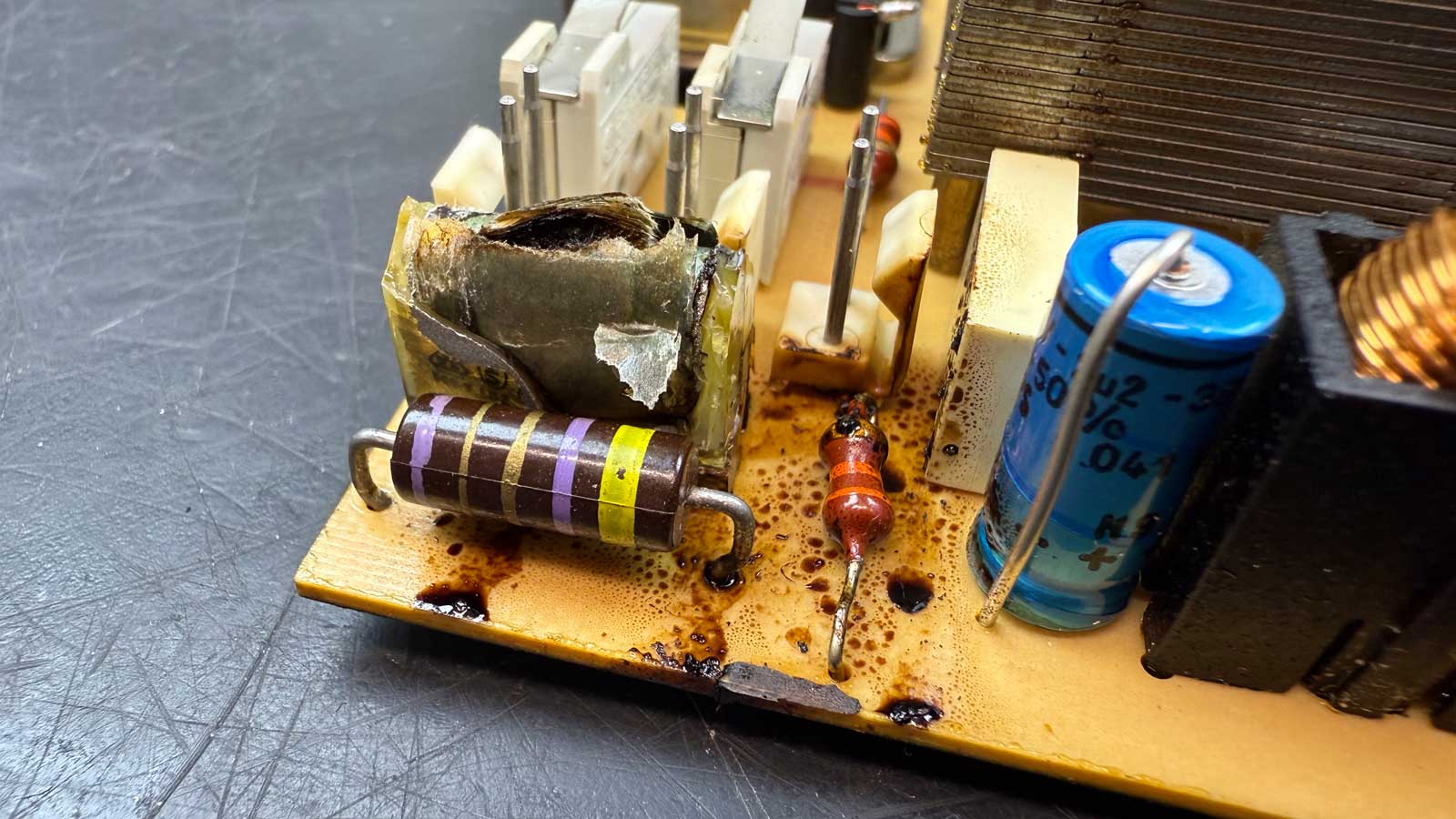
Remove or replace capacitor?
The main reason I am writing this blog post is the large amount of conflicting and partly misleading information I have seen regarding the use of suppression capacitors. The question often arises: Is it acceptable to simply remove the capacitor, or must it be replaced with a new one?
I have heard many explanations as to why it is supposedly completely unproblematic to remove it, but these claims are to a small extent based on professional knowledge. Unfortunately, several of them have been passed on as facts, without source criticism – often by people without formal education or experience in electronics.
I am a certified service electronics technician and have previously worked as a radio and TV repair technician. A significant part of both my education and professional experience has involved regulations, safety, and the correct repair and design of electrical equipment. Based on this, there is only one correct answer for me: A defective suppression capacitor must be replaced – not removed.
Below I explain in more technical terms why I am so clear about this.
Regulations and standards – this is not optional
Suppression capacitors (often called EMI or mains capacitors) are not installed in electrical equipment because the manufacturer "felt like it", but because regulations and harmonized standards require it. In Europe – including Norway and the rest of Scandinavia – this is regulated through the EEA agreement and common European regulations.
The most important frameworks are:
EMC Directive (2014/30/EU)
This directive requires that electrical equipment:
- does not interfere with other equipment via the mains or electromagnetic radiation
- itself tolerates normal electromagnetic influence
A sewing machine motor without proper noise suppression does not meet these requirements. Removing the suppression capacitor changes the EMC properties of the device and means that it no longer complies with what has been tested and approved.
Low Voltage Directive (2014/35/EU)
This directive concerns electrical safety and covers, among other things:
- overvoltages
- transients (fast high-voltage pulses)
- insulation and protection against electric shock
The suppression capacitor is often part of the safety barrier between mains voltage and the user. This particularly applies to X- and Y-class capacitors.
Harmonized standards (also relevant in Norway, Sweden, and Denmark)
Sewing machines and similar equipment are usually tested according to standards such as:
- EN 55014-1 / EN 55014-2 (EMI from household appliances and motors)
- EN 60335-1 (general safety for electrical household appliances)
These standards require active noise suppression, and the tests are carried out with the suppression capacitors installed. If they are removed, the device is by definition no longer compliant.
Important point:
When a repair technician removes a suppression capacitor, he has in practice changed the construction of the device. It is no longer the product that was originally CE-marked, or Nemko-marked on older machines.
How a suppression capacitor works – explained technically
A sewing machine motor (especially universal motors with brushes) generates rapid voltage changes, sparking in the brushes and high-frequency pulses.
These pulses propagate back into the mains and radiate as electromagnetic noise, witch can affect both the device itself and other equipment.
The role of the suppression capacitor
A suppression capacitor acts as:
- a low-impedance path for high-frequency noise
- a damper for rapid voltage changes (dv/dt)
- a filter between the device and the mains
Depending on placement:
- X capacitors (between phase and neutral) suppress differential noise
- Y capacitors (to earth/chassis) safely divert common-mode noise
These capacitors are safety-classified and designed to:
- fail in a controlled manner
- not short-circuit to earth or mains
- withstand continuous mains voltage and transients
Ordinary "cheap" capacitors do not have these properties.
What can happen if the suppression capacitor is removed?
The fact that the sewing machine "runs" does not mean that it is safe, stable, or correct.
Possible consequences include:
1. Increased electromagnetic noise
- Wi-Fi interference
- problems with LED lighting, dimmers, radio
- noise fed back into the mains affecting other equipment
2. Increased wear and faults in the machine
- more sparking in the motor
- higher electrical stress on switches, triacs, and electronics
- shorter component lifespan
3. Safety risk
- higher overvoltages inside the machine
- greater risk in case of faults in the motor or mains
- loss of a defined return path for noise currents
4. Legal and professional responsibility
- the machine is no longer compliant with the CE or Nemko basis
- the repair technician has made a design change
- liability in case of damage may ultimately fall on the person who performed the "repair"
"It works without it..." is not a technical argument
The fact that a machine seemingly works without a suppression capacitor is by no means proof that it is correct, safe, legal, or professionally executed. It is the equivalent of claiming it is perfectly fine to drive a car without a seatbelt, bypass the grounding, or use the wrong fuse in a fuse box. A great many things in this world "work" perfectly well – until the day they suddenly do not.
My professional attitude
Simply removing a component and calling it a day just because the machine starts up goes against everything I have learned and how I operate.
To me, electronics repair is not just about making things work in the moment – it is about operational reliability, quality, and long-term safety. In cases where I actually alter the value of a component or make modifications to an electronic circuit, it is never done at random. There is always a thorough, professional assessment behind it.
As a professional, I carry a great responsibility toward the person who will be using the equipment after I have repaired it. That is a responsibility I take with the utmost seriousness.
A concrete example of this is if a suppression capacitor is defective: It must be replaced with a new component that has the same or better specifications – it must never simply be removed. Taking the path of least resistance like that is, in my opinion, poor craftsmanship, in violation of current regulations, and above all, disrespectful to both the machine and the customer who is paying for a safe repair.
- Theodor Bastberget